The best place to begin our analysis of The Legend of Korra is with Korra herself.
Both Avatar series were filled with lush, multidimensional characters that display human emotions and experience real change. The four seasons of Legend of Korra span more than 3 years, and every major character learns lessons and adapts to new realities as time passes. In some cases, we get to see characters evolve over generations (such as the elderly characters were young in The Last Airbender, or children of those characters).
And it’s not only the major characters who display such depth. The villains always have clear motives and strategies. The side characters, even those who are there for comic relief, are defined with a personal style, goals, and challenges. I’ll go into some of these side characters in a future post, but for now let’s focus on Korra.
Book 1: Air
In season 1, we are introduced to Korra.
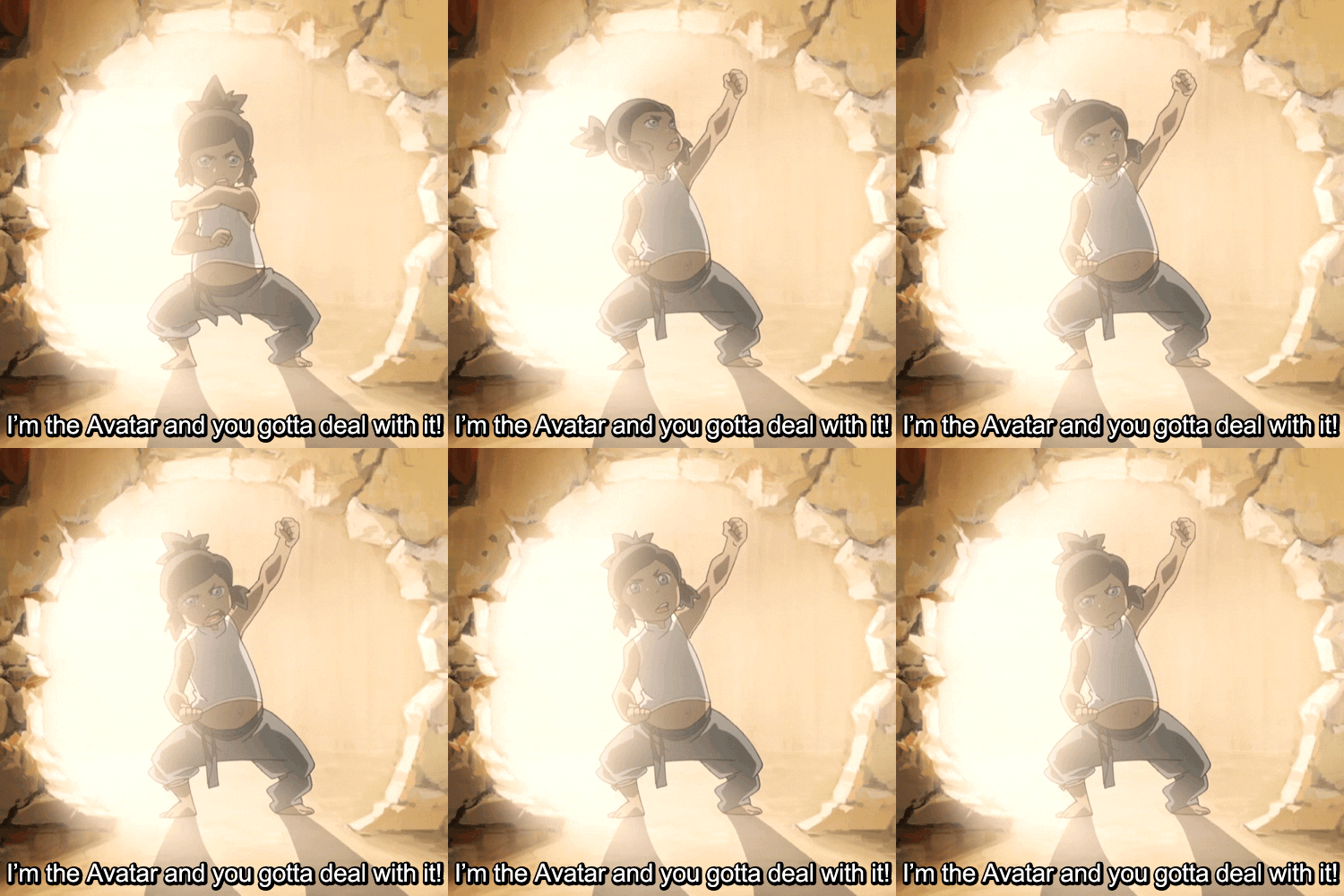
We meet baby Korra in this terrific flashback. It shows us so much about Korra in one quick scene. She was bending and pushing people out of her way ever since she was a toddler. Korra’s entire journey is contained in this image.
As we spend more time with teenage Korra, we learn that she’s athletic, strong-willed, independent, and impatient. Her struggle throughout Book 1 becomes clear right away: she can’t airbend. She’s learned to bend water, earth, and fire, but air is posing a peculiar challenge for her. And this, of course, is a symptom of a deeper problem: Korra is having trouble letting go. She has too much willpower and is unwilling to surrender. That’s the beauty of this character–her exterior struggle (inability to airbend) is a reflection of her inner struggle (inability to surrender).

The show exposes Korra’s struggle in very elegant ways. Yes, we see Korra’s literal struggle as she fails at airbending challenges. But more important to the exposition is Korra’s relationship to her airbending teacher, Tenzin. As Tenzin pushes Korra to exercise patience and discipline, he only triggers her impatience. She hates meditating and refuses to develop her spirituality, which is a key component of airbending. Even though Tenzin forbids it, Korra joins a pro bending team, where she exercises fighting and aggression, not patience. The tension between the student and teacher is a perfect way to expose Korra’s personal struggle. And to add another layer of intrigue to the story, Tenzin is Avatar Aang’s son and one of only 4 living airbenders. Both Korra and Tenzin are, in different senses, future incarnations of Aang. Korra (Aang’s spiritual descendant) must unblock her avatar spirit–and her connection to her past lives–by learning to relate to Tenzin (Aang’s genetic descendant). It’s truly poetic!
OK, but so what if Korra can’t airbend? That’s not enough of a story. Something bigger needs to happen in order for the audience to care. So, let’s raise the stakes!
Early in the season, we learn of the Equalists, a movement of people who want non-benders to have as much respect as benders. At first, this sounds like a reasonable mission (and it adds an interesting bit of texture to the political world building), but as we learn more about the devious plans of Amon, leader of the Equalists, we understand how much is in jeopardy. If Korra doesn’t stop Amon, he’s going to wipe away the bending abilities of thousands of people, destroying generations of cultural legacy. In order to meet this challenge, Korra will have to learn to enter the avatar state, but she can’t do that unless she learns how to bend all four elements! Now the fate of the city hinges on Korra’s ability to face her demons, accept her teacher, and expand her consciousness.
And voila! We have a story.
In the final act of the season, Amon succeeds in stealing Korra’s ability to bend water, earth, and fire (but can’t take her airbending, as she hasn’t unlocked it yet). Having lost her bending, Korra hits rock bottom, but she doesn’t give up fighting. She does what she can to stop Amon and, in a beautiful, desperate moment, realizes that she can airbend.

Korra’s triumph comes directly out of her lowest moment. It’s only after being knocked down that Korra can reach deep within herself and unblock the one ability she’s been missing. Once she discovers her airbending, Korra connects to the avatar state, learns to energybend, and restores the bending of those who have lost it, including herself. We end the season on this victorious note, with Korra having achieved the avatar state.

Korra enters the Avatar State
Now let’s take a step back and see what lessons we can glean from Korra’s journey.
What is a ‘character arc’?
Simply put, arcs are changes over time.
Korra goes through a journey. She changes. Korra in episode 1 is not the same as Korra in episode 12. Of course, how she gets there is the interesting part. As you know, the journey is not about the destination, it’s about the steps you take to get there. BUT, when we’re talking about story, the starting point and the destination define the arc. Start with this simple principle:
Where the character is at the beginning ≠ Where the character is at the end.
This must be true within every season (seasonal arc) and episode (episodic arc). Yes, there are arcs within arcs! There are even scene arcs. That’s right–in EVERY scene, something must shift (even if it’s a small shift).
So, how do you do it? How do you create enough interesting changes over the course of an entire season? That’s like hundreds of scenes. Don’t you just run out of changes after a while? No, you don’t, because changes are cyclical, and they’re back-and-forth, and they’re layered. Right now, we’re focusing on Korra’s big season-long arc, but there are also smaller story arcs, including other characters’ arcs (e.g. Tenzin’s attitude changes, shifting political forces in Republic City, romantic developments between characters, backstory reveals, alliances, betrayals, red herrings, etc. etc.!)
In order to build enough tension through the course of a long-form story (such as a novel, movie, or TV season), the main character should travel along a single “axis.” The push-and-pull of character development all happens around this axis. I call it:
The Character Dichotomy
Every character has a central asset and a central flaw. Now, here’s the big, important trick. The asset and the flaw are THE SAME. Huh? How can an asset and a flaw be the same? Answer: they’re two sides of the same coin. To illustrate this, let’s return to the example of Korra.
If I had to choose one word that defines Korra it would be strength.
Clearly, Korra is strong. But let’s flesh it out. What does this really mean in her case? What are the assets and flaws around this particular attribute?
Korra’s assets, stemming from strength: Physical prowess, Passion, Bravery, Strong will, Independence, Trustworthiness
Korra’s flaws, also stemming from strength: Stubbornness, Unwilling to accept help, Closed off, Overly protected, Hard on herself, Insolence
Korra’s asset/flaw is her strength. You may think “strength” is a bland character trait, but in Korra’s case, the creators have mined this attribute for depth. It should be clear that Korra’s flaws are “shadows” of her assets. In a sense, she’s too strong for her own good. Her own strength, her hardness, is her biggest challenge.
Throughout the entire series, Korra’s challenge is finding a balance between her assets and her shadow aspects. The interplay between these character traits defines her every step of the way.
Now, I don’t want to imply that Korra is one-dimensional, or that all her traits fit into this narrow schema. Nor is this the only way to build a character. However, this is a solid starting point for building or analyzing a character. Why does it work? Because this is human nature. The things we most love are the things that bring us the most pain. Our greatest desires are our greatest fears. And our biggest strengths are our biggest challenges. Don’t believe me? Take a harder look inside yourself.
Next time, we’ll continue the discussion of character arcs, exploring books 2-4 of Korra. Stay tuned!
 The Art of the Story
Pingback: The Legend of Korra: Plotting for High Stakes | The Art of the Story
Pingback: The Legend of Korra | The Art of the Story
Pingback: The Legend of Korra: Character Arcs, Part 2 | The Art of the Story
Brilliant…
LikeLike