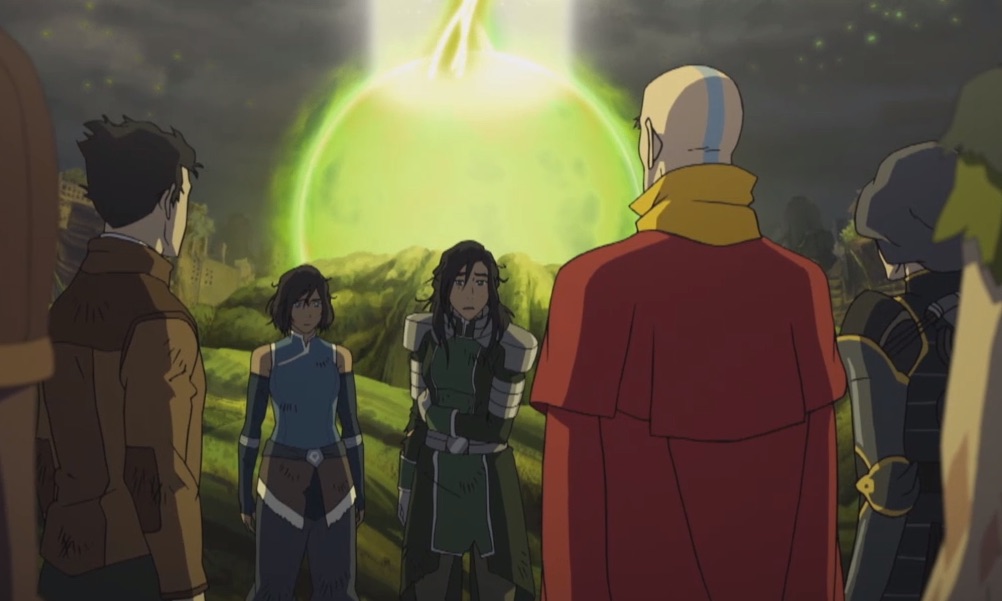
The Legend of Korra: Depth and Texture

One of the reasons so many of us loved The Legend of Korra was because everything about the show–the world, the characters, the art, the plots–felt rich. The people and places of Korra were so well-developed it’s almost as if they were real. It’s not an easy feat to create a show with so much dimension. Today I’m going to break down some of the techniques the creators used to reach this level of depth and texture.

Texture in Character

Texture can appear anywhere: in characters, sets, costumes, dialogue, animation, and so on. Let’s look at two of my favorite characters, the brothers Mako and Bolin, to see how they were given texture.

Mako and Bolin

Mako and Bolin

We can all recognize when a character feels flat or one-dimensional. But how do you go about giving characters dimension? I wasn’t in the Legend of Korra writers’ room (except in my dreams), but I imagine that the show’s creators answered character questionnaires–like these from Gotham Writers Workshop–about all their main characters. That’s a great first step to developing your characters (and if you don’t do it formally on paper, at least do it in conversation with your writing partners).

But characters really come to life when you give them space to surprise you. You must let them break the mold of their character questionnaire.

Consistency vs. Variation

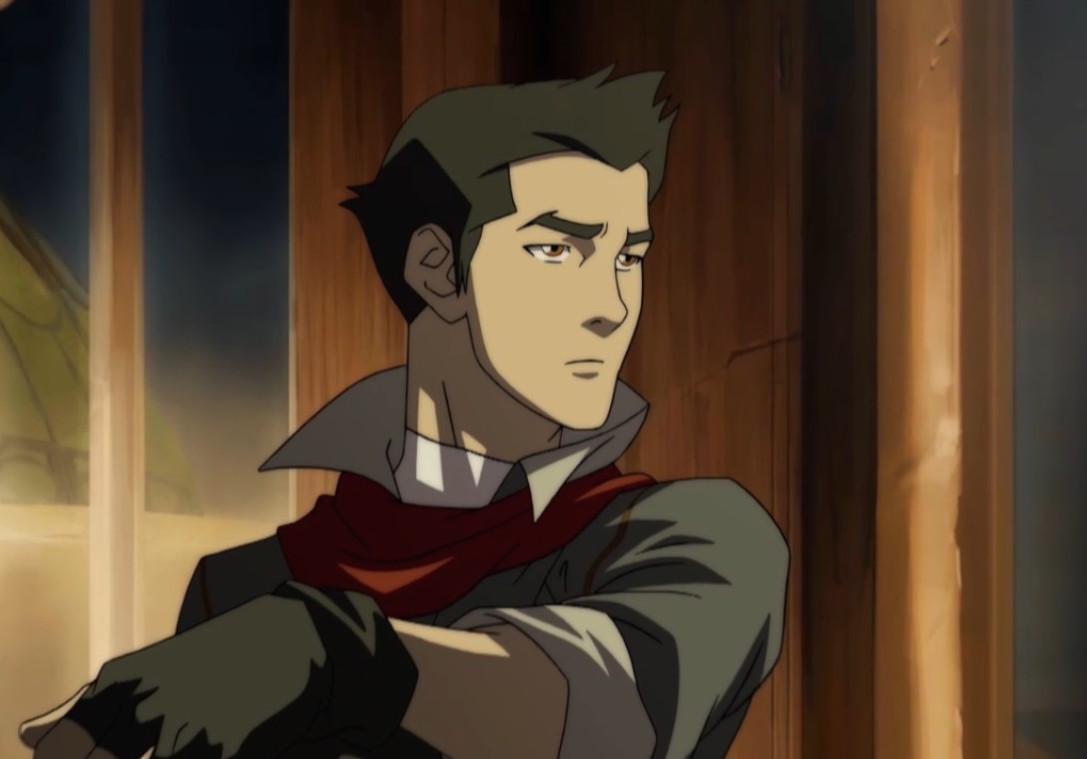
They key is to give your characters grounding in some consistent character traits while allowing them to be human. For example, Mako is quiet, serious, and brooding while Bolin is goofy and spontaneous. However, they are not ONLY those things. If Mako and Bolin went around being nothing but serious and goofy all the time, they’d be second-rate sidekicks. What gives them dimension is BOTH their consistency AND their variation from their central traits.

For example, Mako has a short temper. He often has bouts of fiery anger that go against his usual calm self. He can also be extremely tender around women, letting his emotional sides show. But at the end of the day, Mako always comes back to his centered, thoughtful self.
Kora_Mako

Bolin, on the other hand, loves to laugh and never shies away from expressing himself. He’s a great foil to his brother. But Bolin isn’t only comic relief. He shows his tender and thoughtful sides when he talks to his girlfriend Opal, or when he decides to turn against Kuvira. We saw Bolin mature over the course of the series, going from a brash and self-centered player to a more serious man of politics.

Korra_Bolin

Mako and Bolin’s central character traits help them feel grounded. But if they were too consistent, they wouldn’t feel human. It’s a delicate balance to strike, and it’s the key to creating textured characters.

Depth

Mako and Bolin get even more interesting when you consider their relationships to one another and to their family. We learn early on that these two boys were orphaned. For the first two seasons of Korra, it appears that Mako and Bolin have no family. But then, in season 3, the brothers go to Ba Sing Se, where they meet their enormous extended family. A great reversal!

Korra_MakoBolinFamily

The writers weren’t content to say Mako and Bolin are orphans, let’s leave it at that. They recognized that every orphan has his own story. They dug deeper by asking:

  • How did Mako and Bolin’s parents die?
  • How did their parents get together in the first place?
  • What brought them, an earth bender and a fire bender, to Republic City?
  • Where are the families that they left behind?
  • Is it possible their families are still alive? Can Mako and Bolin meet them?

Yes! Mako and Bolin can meet their long-lost family. This was a stroke of brilliance because it gave the boys a history. It connected them to the realities of society and geography in their world.

An old letter and photograph from Mako and Bolin's father

An old letter and photograph from Mako and Bolin’s father

Nothing exists in a vacuum. It’s not enough to pigeonhole your characters. Dig deeper. How did they get that way? What forces in the world brought them to where they are today?

The Beifongs

beifongs

As a closing exercise, let’s take a look at a different family. In season 1, we met Lin Beifong, who was an interesting character in her own right. Again, I wasn’t in the writer’s room, but I imagine the writers asked themselves these questions:

  • How did Lin become the person who she is?
  • What family dynamics in her childhood made her so hard and unforgiving?

The answer they came up with: Lin had a half-sister, Su, who was a bit of a floozy. Lin and Su were polar opposites who fought for the attention and respect of their mother. In a major family incident, Su was arrested and Lin was left to clean up the mess. But the writers didn’t stop there. They asked:

  • Where is Su now?
  • Are Lin’s feelings resolved?
  • If these sisters were to meet today, what would their relationship be like?

As soon as they started digging deeper, they realized they had a story there. By asking the right questions, the creators revealed depth in their fictional world.

The creators built out Su’s life and came up with this family tree.

Korra_BeifongFamilyTree

The Beifong Family Tree

It was a risky move to introduce so many new characters in season 3, especially since they were only distantly related to one of the adult side characters (Lin). And it must have been a daunting task to breathe life into all of them.

But the writers pulled it off, and brilliantly. They spent the time developing each of the Beifongs into fully-fleshed out people. Su, Baatar Jr., and Opal all turned out to be complex characters with their own nuances. They all show texture through consistency and variation. Baatar Sr., Huan, Wei, and Wing were side characters, so it’s okay that those characters were more one-dimensional.

By weaving this large family into the fabric of Korra’s world, the show creators made a rich, vibrant, and textured tapestry.

For my closing argument, I give you this image of Huan, the artist, studying his sculpture.

Korra_Beifongs

A brilliant image because you can see all of the different characters expressed through their faces. Korra’s compassion. Su’s warmth. Bolin’s cluelessness. Lin’s hardness.

This is why we love The Legend of Korra. Because the writers, designers, and animators never got lazy. They used every line of dialogue and every frame of animation to reveal the humanity of their characters and their world.

Thank you for taking this journey with me!

The Legend of Korra: Character Arcs, Part 2

Last time, we explored the assets and flaws that define Korra’s character. We saw how many of her traits fall along an axis, revolving around different aspects “strength.” In Book 1, Korra had to soften her will in order to come into balance. Today we’ll take a closer look at her character development in Books 2, 3, and 4.

Book 2: Spirits

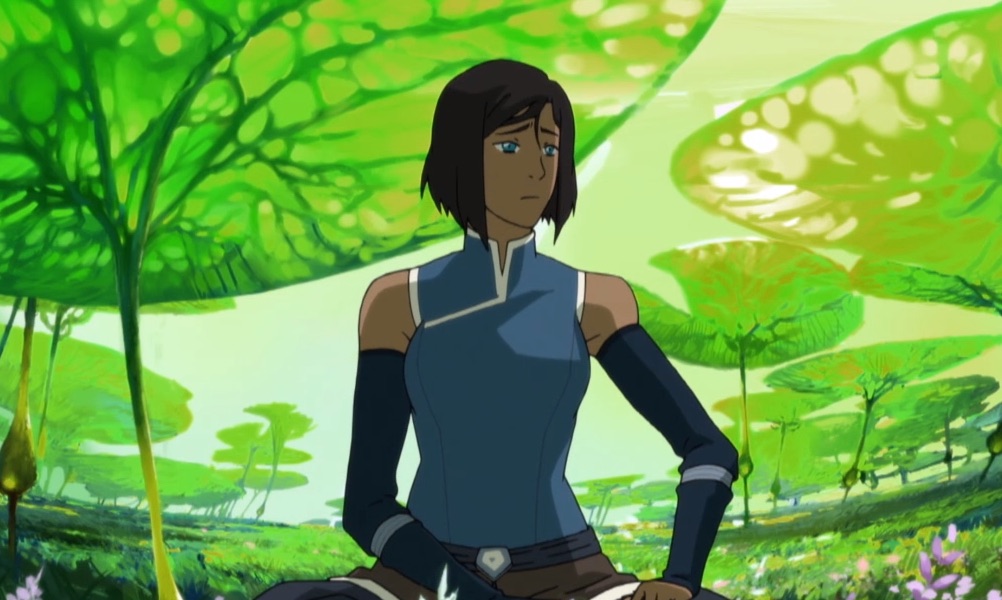
Korra Meditates

Korra begins book 2 having learned to airbend and enter the avatar state. She is finally open to meditating with her teacher Tenzin (though she still doesn’t love it).

As the season progresses, Korra will be challenged to further explore her connection to spirit. This is not something that comes easily to her–Korra is naturally physically strong and brave, but she has to work on her “inner strength,” developing attributes like faith, trust, and openness.

A conflict enters the stage, again raising the stakes for Korra (and for the entire world). This time, Korra has to deal with two challenges: 1) A Civil War between the Northern and Southern water tribes and 2) Reports of spirits attacking humans in the ocean. She’ll soon learn that these are two edges of the same sword–her uncle Unalaq is responsible for the war as well as the agitation in the spirit world.

Unalaq threatens to merge with Vaatu, a great dark spirit, which would make him the dark avatar, a chaotic mirror to Korra and all the avatars that have come before her. This puts the entire avatar lineage in jeopardy. In order to defeat him, Korra must once again do that which is most difficult for her. She must enter the spirit world, take control of her own emotions, and find her connection to Raava, the great light spirit.

What’s so wonderful about this season is that it gives us the origin story of the Avatar, but it does so seamlessly as part of Korra’s journey. As Korra learns about Wan, the first avatar, the audience also learns about him, enriching our sense of the avatar’s history, and rounding out our knowledge of the Avatar world.

2KorraSpiritBattle

Unalaq actually succeeds in destroying Korra’s connection to Raava, and severing all memory of her past lives. It’s a terrible blow to Korra, and and a handicap she’ll have to live with forever. The show creators make a bold move by allowing their main character to experience such a painful tragedy. Once again, Korra is sent to a dark, low, defeated place, from which she’ll have to rise up.

2KorraVaatu

Which, of course, she does! By meditating on her inner spirit, Korra is able to extract the spirit of Raava from within Vaatu, because there is always light within dark (and vice versa).

It’s a similar formula to what we saw in Book 1. In order to face a high-stakes enemy that puts the world in danger, Korra must confront her own personal shadows. The enemy succeeds in taking Korra down, devastating her to the point where she’s almost defeated. But Korra draws upon her last untapped bit of inner strength, the one part of herself she’s been unable to access. In doing so, she is able to defeat her enemy and restore peace to the world.

Now, before you accuse me of calling this show formulaic (it’s not!) I want to make one thing clear. Although the broad strokes in Books 1 and 2 are similar, the story is still engaging and surprising. The show creators do not rely on formulas to construct their stories. Rather, they explore the organic truth of their characters, asking the hard questions and taking Korra to difficult places. Then they employ time-tested principles of storytelling to make sure that the plot gives structure and pace to Korra’s journey. That’s how they create a genuine, moving arc that works.

Books 3 and 4: Change and Balance

I’ve decided to tackle Books 3 and 4 together for a few reasons. First of all, the two seasons were written and produced as part of a single process (unlike Book 1 which was written as a stand-alone season). Secondly, Korra doesn’t really have a distinct arc in Book 3. She does go through a major transformation, but it happens only in the last 2 episodes of that season. For the majority of Book 3, Korra is her good ol’ ass-kicking self. Is that a story problem? Not really. It’s just a decision the show creators made, and it works well.

Even though Korra doesn’t face any life-threatening or soul-defining challenges in those first 11 episodes of Book 3, there is enough action to keep us interested. For example, the introduction of new airbenders, including the layered character of Kai, gives us plenty to think and feel about. The evolution of the new air nation, Bumi and other individuals discovering their talents, Jinora’s self-development, several romantic connections, the introduction of Mako and Bolin’s extended family, the political intrigue of the Earth Queen, and the wonderfully realized sibling rivalry of Lin and Su Beifong all keep us engaged. So there’s plenty of story there, but for now I’m focusing on Korra, so let’s get to the juicy part!

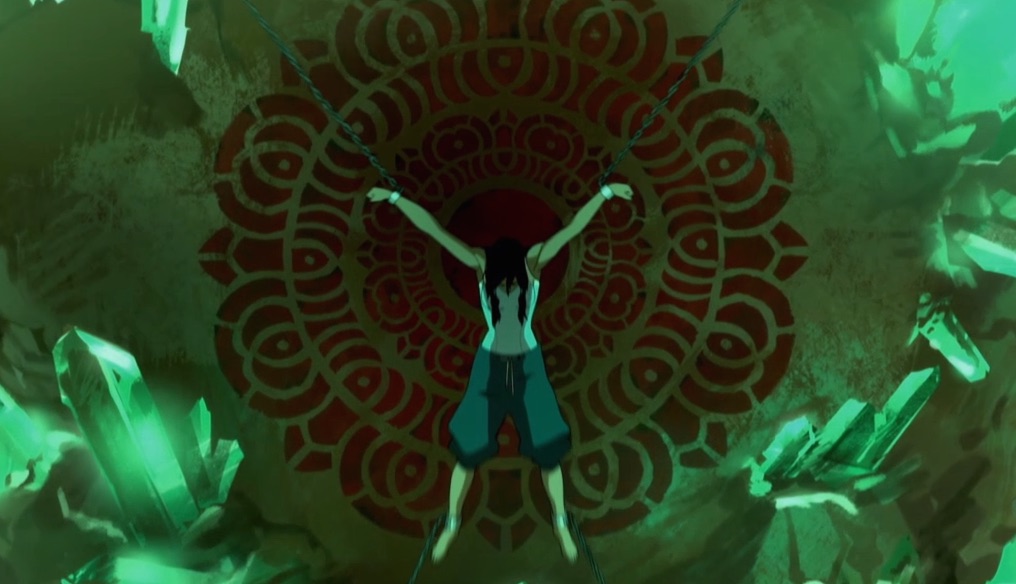
3KorraCaptive

At the end of the season, Korra is captured by Zaheer, who poisons her with a metallic substance that sends her uncontrollably into the avatar state, putting her at risk of ending the entire avatar cycle.

3KorraPoisoned

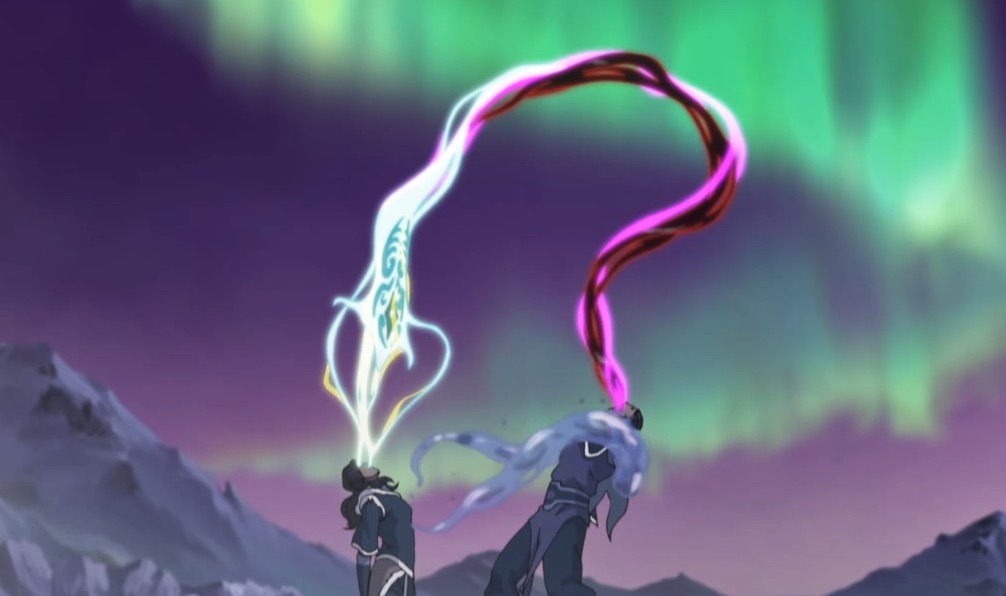
Zaheer begins to steal Korra’s breath with his airbending.

3KorraBreath

This event serves as BOTH the climax for Book 3 and the inciting incident for Korra’s journey in Book 4.

Of course, Korra is able to defeat Zaheer and his clan, but Book 3 ends in an unusual place for a kids’ show–with Korra bound to a wheelchair and crying.

4KorraWheelchairBook 4 is where The Legend of Korra really proved itself to be a mature show. It took this horrific incident–Korra being poisoned and robbed of her breath–and treated it with an adult touch. The creators humanized Korra by asking, What would really happen to a person who went through this trauma? They decided that Korra was no longer going to be an invincible cartoon character. They gave her human vulnerability. They gave her PTSD.

4KorraTherapy

This is different from anything we’ve ever seen on a TV show for this age level. Korra, robbed of her vitality, had to go through physical and emotional therapy to heal from the post-traumatic stress of her encounter with Zaheer. And here we were as an audience watching an animated character become so vulnerable that we couldn’t help but see her as human. That’s a powerful takedown of traditional storytelling norms, at least for children’s television.

The creators took Korra through a real healing process. She didn’t recover overnight; it took over 3 years. She struggled to walk again. She fell many times and she got back up. She lashed out at her healer Kitara. She pushed away those who care for her. She lied to her parents and went into hiding. She chopped off her hair. She lost much of her physical prowess and her notoriety as the avatar. She lost her connection to the spirit world.

Korra began Book 4 at her lowest point yet. This was her rock bottom for the entire series. The show’s creators turned their formula from Books 1 and 2 on its head. Instead of beginning strong and confronting a strong enemy, Korra began the season weak and had to build herself slowly to regain her power. This is a whole different character arc.

Korra was plagued with fear and poison. After a lonely journey across the world and into the spirit swamps she found Toph, an old avatar ally, who helped her extract the last of the poison (but only after much failure and resistance). Korra now thinks she’s ready to face Kuvira, the military aggressor and latest, greatest villain. But in a one-on-one battle with Kuvira, Korra’s nightmares haunt her again and she falls, defeated.

The beauty of Korra’s situation was that she had to heal herself. Just like in real life. What was really blocking her from reconnecting to herself was not the metallic poison (although that certainly wasn’t helping), but her fear. Every time Korra tried to return to battle, or to get better, she had flashbacks of all her traumatic events–the battle with Amon, the severing of her connection to Raava, but most of all her battle with Zaheer. In order to overcome her fear, Korra had to face its source by visiting Zaheer himself.

4KorraFacesEnemies

In one of the most poignant scenes of the series, Korra returned to visit her imprisoned enemy Zaheer and endured the traumatic flashbacks. She had to suffer through her fear in order to understand that her fear couldn’t kill her. That’s when she found peace, and her return to the spirit world. Her greatest enemy was the only one who could return her to the spirit world.

4InSpiritWorld

And to her connection with Raava. Korra finally becomes her whole self again.

4KorraVaatu

This is the crucial turning point in Korra’s Book 4 arc.

What’s so meaningful about this journey is that Korra was shown depths of suffering she had never seen before, and the only way out of that suffering was confronting her enemies heart-to-heart. That confrontation softened her in a way that she had never been softened before. It taught her compassion–for herself, her own fear and suffering, as well as for the suffering of her enemies.

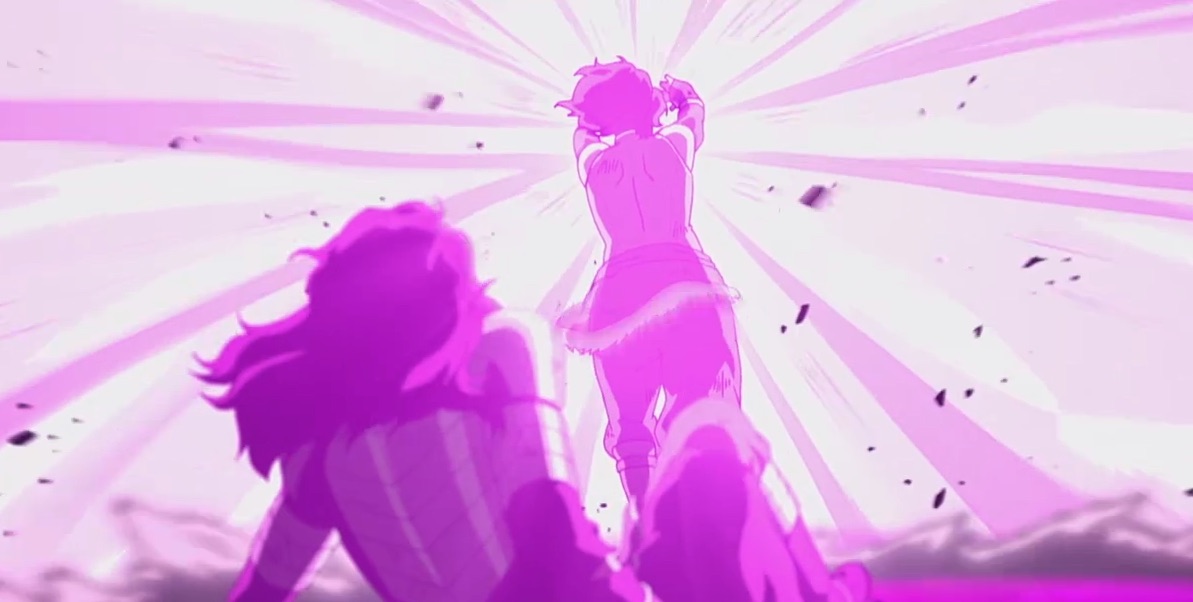
Thus, when Korra faces Kuvira in one final, epic battle in Republic City, she is able to take a bold step.

4KorraSavesKuvira

She puts herself in harm’s way in order to protect her enemy. Even though Kuvira has shown no remorse, wrecked Republic City, and destroyed the entire world’s social order, Korra saves her life (notably, Kuvira was endangered by her own mega-weapon). Korra understands that Kuvira, an orphan, has suffered much. She sees that Kuvira’s hostility was a due to her personal pain. She actually feels compassion for the woman that has caused so much mayhem and destruction.

4KorraKuvira

The Korra of Book 1 did not have this level of maturity. It’s only after facing such deep personal challenges that Korra finally brings her strength into balance with compassion. And this compassion pays off. Kuvira tells her troops to stand down, and the world comes to a greater sense of ease and understanding.

That is the culmination of Korra’s journey for the entire series. See, Korra’s arc through Books 3 and 4 completes who she’s been all along. By the end she has developed into a strong, faithful, compassionate warrior. She has truly brought the assets and flaws of her strength into balance!

Thank you for taking this journey with me and Korra.

Next time: Building the Avatar world.

The Legend of Korra: Character Arcs, Part 1

The best place to begin our analysis of The Legend of Korra is with Korra herself.

Both Avatar series were filled with lush, multidimensional characters that display human emotions and experience real change. The four seasons of Legend of Korra span more than 3 years, and every major character learns lessons and adapts to new realities as time passes. In some cases, we get to see characters evolve over generations (such as the elderly characters were young in The Last Airbender, or children of those characters).

And it’s not only the major characters who display such depth. The villains always have clear motives and strategies. The side characters, even those who are there for comic relief, are defined with a personal style, goals, and challenges. I’ll go into some of these side characters in a future post, but for now let’s focus on Korra.

Book 1: Air

In season 1, we are introduced to Korra.
1BabyKorra

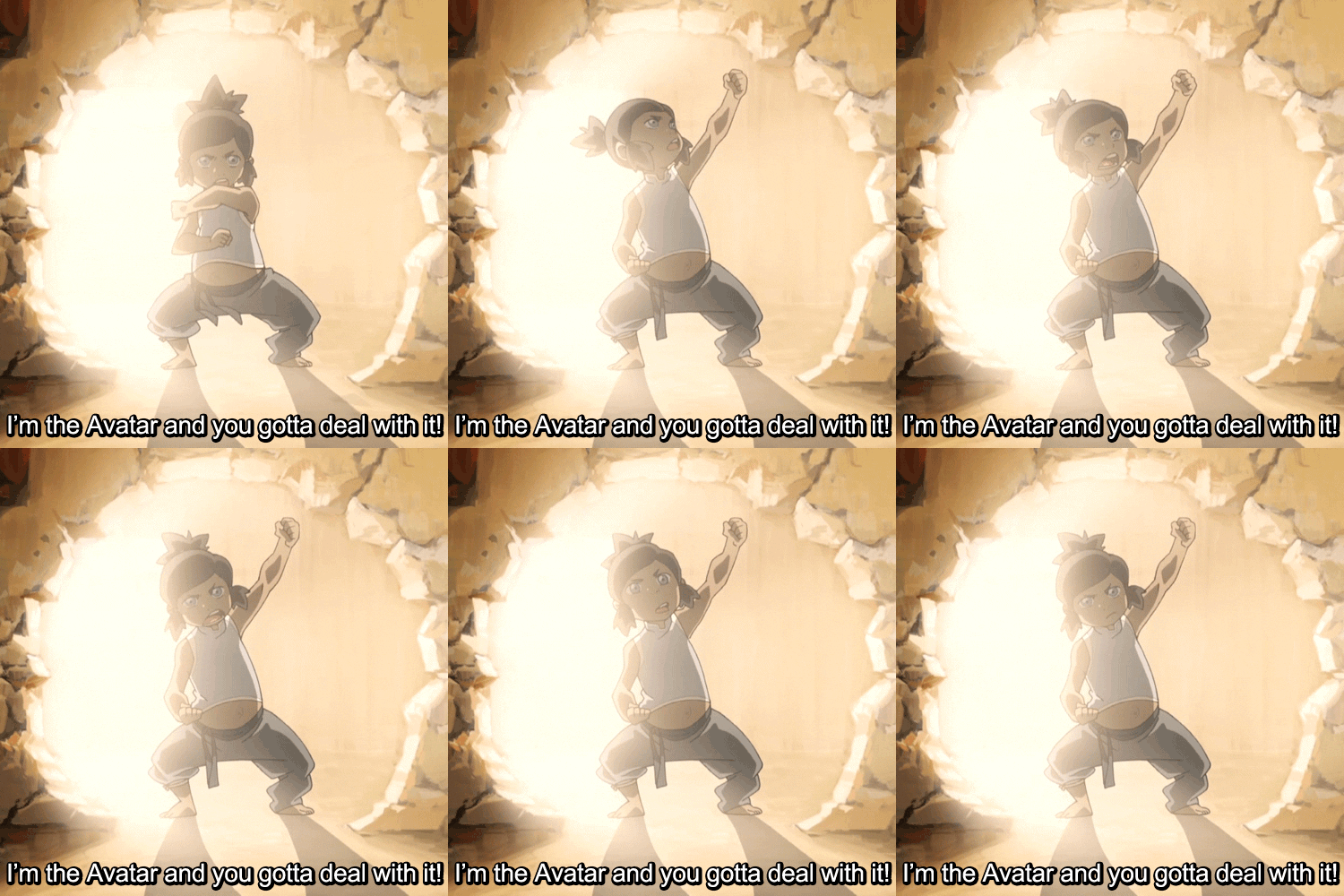
We meet baby Korra in this terrific flashback. It shows us so much about Korra in one quick scene. She was bending and pushing people out of her way ever since she was a toddler. Korra’s entire journey is contained in this image.

As we spend more time with teenage Korra, we learn that she’s athletic, strong-willed, independent, and impatient. Her struggle throughout Book 1 becomes clear right away: she can’t airbend. She’s learned to bend water, earth, and fire, but air is posing a peculiar challenge for her. And this, of course, is a symptom of a deeper problem: Korra is having trouble letting go. She has too much willpower and is unwilling to surrender. That’s the beauty of this character–her exterior struggle (inability to airbend) is a reflection of her inner struggle (inability to surrender).

KorraStumbles

The show exposes Korra’s struggle in very elegant ways. Yes, we see Korra’s literal struggle as she fails at airbending challenges. But more important to the exposition is Korra’s relationship to her airbending teacher, Tenzin. As Tenzin pushes Korra to exercise patience and discipline, he only triggers her impatience. She hates meditating and refuses to develop her spirituality, which is a key component of airbending. Even though Tenzin forbids it, Korra joins a pro bending team, where she exercises fighting and aggression, not patience. The tension between the student and teacher is a perfect way to expose Korra’s personal struggle. And to add another layer of intrigue to the story, Tenzin is Avatar Aang’s son and one of only 4 living airbenders. Both Korra and Tenzin are, in different senses, future incarnations of Aang. Korra (Aang’s spiritual descendant) must unblock her avatar spirit–and her connection to her past lives–by learning to relate to Tenzin (Aang’s genetic descendant). It’s truly poetic!

OK, but so what if Korra can’t airbend? That’s not enough of a story. Something bigger needs to happen in order for the audience to care. So, let’s raise the stakes!

Early in the season, we learn of the Equalists, a movement of people who want non-benders to have as much respect as benders. At first, this sounds like a reasonable mission (and it adds an interesting bit of texture to the political world building), but as we learn more about the devious plans of Amon, leader of the Equalists, we understand how much is in jeopardy. If Korra doesn’t stop Amon, he’s going to wipe away the bending abilities of thousands of people, destroying generations of cultural legacy. In order to meet this challenge, Korra will have to learn to enter the avatar state, but she can’t do that unless she learns how to bend all four elements! Now the fate of the city hinges on Korra’s ability to face her demons, accept her teacher, and expand her consciousness.

And voila! We have a story.

In the final act of the season, Amon succeeds in stealing Korra’s ability to bend water, earth, and fire (but can’t take her airbending, as she hasn’t unlocked it yet). Having lost her bending, Korra hits rock bottom, but she doesn’t give up fighting. She does what she can to stop Amon and, in a beautiful, desperate moment, realizes that she can airbend.

KorraAirbends

Korra’s triumph comes directly out of her lowest moment. It’s only after being knocked down that Korra can reach deep within herself and unblock the one ability she’s been missing. Once she discovers her airbending, Korra connects to the avatar state, learns to energybend, and restores the bending of those who have lost it, including herself. We end the season on this victorious note, with Korra having achieved the avatar state.

Korra enters the Avatar State

Korra enters the Avatar State

Now let’s take a step back and see what lessons we can glean from Korra’s journey.

What is a ‘character arc’?

Simply put, arcs are changes over time.

Korra goes through a journey. She changes. Korra in episode 1 is not the same as Korra in episode 12. Of course, how she gets there is the interesting part. As you know, the journey is not about the destination, it’s about the steps you take to get there. BUT, when we’re talking about story, the starting point and the destination define the arc. Start with this simple principle:

Where the character is at the beginning ≠ Where the character is at the end.

This must be true within every season (seasonal arc) and episode (episodic arc). Yes, there are arcs within arcs! There are even scene arcs. That’s right–in EVERY scene, something must shift (even if it’s a  small shift).

So, how do you do it? How do you create enough interesting changes over the course of an entire season? That’s like hundreds of scenes. Don’t you just run out of changes after a while? No, you don’t, because changes are cyclical, and they’re back-and-forth, and they’re layered. Right now, we’re focusing on Korra’s big season-long arc, but there are also smaller story arcs, including other characters’ arcs (e.g. Tenzin’s attitude changes, shifting political forces in Republic City, romantic developments between characters, backstory reveals, alliances, betrayals, red herrings, etc. etc.!)

In order to build enough tension through the course of a long-form story (such as a novel, movie, or TV season), the main character should travel along a single “axis.” The push-and-pull of character development all happens around this axis. I call it:

The Character Dichotomy

Every character has a central asset and a central flaw. Now, here’s the big, important trick. The asset and the flaw are THE SAME. Huh? How can an asset and a flaw be the same? Answer: they’re two sides of the same coin. To illustrate this, let’s return to the example of Korra.

If I had to choose one word that defines Korra it would be strength.
Clearly, Korra is strong. But let’s flesh it out. What does this really mean in her case? What are the assets and flaws around this particular attribute?
Korra’s assets, stemming from strength: Physical prowess, Passion, Bravery, Strong will, Independence, Trustworthiness
Korra’s flaws, also stemming from strength: Stubbornness, Unwilling to accept help, Closed off, Overly protected, Hard on herself, Insolence

Korra’s asset/flaw is her strength. You may think “strength” is a bland character trait, but in Korra’s case, the creators have mined this attribute for depth. It should be clear that Korra’s flaws are “shadows” of her assets. In a sense, she’s too strong for her own good. Her own strength, her hardness, is her biggest challenge.

Throughout the entire series, Korra’s challenge is finding a balance between her assets and her shadow aspects. The interplay between these character traits defines her every step of the way.

Now, I don’t want to imply that Korra is one-dimensional, or that all her traits fit into this narrow schema. Nor is this the only way to build a character. However, this is a solid starting point for building or analyzing a character. Why does it work? Because this is human nature. The things we most love are the things that bring us the most pain. Our greatest desires are our greatest fears. And our biggest strengths are our biggest challenges. Don’t believe me? Take a harder look inside yourself.

Next time, we’ll continue the discussion of character arcs, exploring books 2-4 of Korra. Stay tuned!