Last time, we explored the assets and flaws that define Korra’s character. We saw how many of her traits fall along an axis, revolving around different aspects “strength.” In Book 1, Korra had to soften her will in order to come into balance. Today we’ll take a closer look at her character development in Books 2, 3, and 4.
Book 2: Spirits

Korra begins book 2 having learned to airbend and enter the avatar state. She is finally open to meditating with her teacher Tenzin (though she still doesn’t love it).
As the season progresses, Korra will be challenged to further explore her connection to spirit. This is not something that comes easily to her–Korra is naturally physically strong and brave, but she has to work on her “inner strength,” developing attributes like faith, trust, and openness.
A conflict enters the stage, again raising the stakes for Korra (and for the entire world). This time, Korra has to deal with two challenges: 1) A Civil War between the Northern and Southern water tribes and 2) Reports of spirits attacking humans in the ocean. She’ll soon learn that these are two edges of the same sword–her uncle Unalaq is responsible for the war as well as the agitation in the spirit world.
Unalaq threatens to merge with Vaatu, a great dark spirit, which would make him the dark avatar, a chaotic mirror to Korra and all the avatars that have come before her. This puts the entire avatar lineage in jeopardy. In order to defeat him, Korra must once again do that which is most difficult for her. She must enter the spirit world, take control of her own emotions, and find her connection to Raava, the great light spirit.
What’s so wonderful about this season is that it gives us the origin story of the Avatar, but it does so seamlessly as part of Korra’s journey. As Korra learns about Wan, the first avatar, the audience also learns about him, enriching our sense of the avatar’s history, and rounding out our knowledge of the Avatar world.

Unalaq actually succeeds in destroying Korra’s connection to Raava, and severing all memory of her past lives. It’s a terrible blow to Korra, and and a handicap she’ll have to live with forever. The show creators make a bold move by allowing their main character to experience such a painful tragedy. Once again, Korra is sent to a dark, low, defeated place, from which she’ll have to rise up.

Which, of course, she does! By meditating on her inner spirit, Korra is able to extract the spirit of Raava from within Vaatu, because there is always light within dark (and vice versa).
It’s a similar formula to what we saw in Book 1. In order to face a high-stakes enemy that puts the world in danger, Korra must confront her own personal shadows. The enemy succeeds in taking Korra down, devastating her to the point where she’s almost defeated. But Korra draws upon her last untapped bit of inner strength, the one part of herself she’s been unable to access. In doing so, she is able to defeat her enemy and restore peace to the world.
Now, before you accuse me of calling this show formulaic (it’s not!) I want to make one thing clear. Although the broad strokes in Books 1 and 2 are similar, the story is still engaging and surprising. The show creators do not rely on formulas to construct their stories. Rather, they explore the organic truth of their characters, asking the hard questions and taking Korra to difficult places. Then they employ time-tested principles of storytelling to make sure that the plot gives structure and pace to Korra’s journey. That’s how they create a genuine, moving arc that works.
Books 3 and 4: Change and Balance
I’ve decided to tackle Books 3 and 4 together for a few reasons. First of all, the two seasons were written and produced as part of a single process (unlike Book 1 which was written as a stand-alone season). Secondly, Korra doesn’t really have a distinct arc in Book 3. She does go through a major transformation, but it happens only in the last 2 episodes of that season. For the majority of Book 3, Korra is her good ol’ ass-kicking self. Is that a story problem? Not really. It’s just a decision the show creators made, and it works well.
Even though Korra doesn’t face any life-threatening or soul-defining challenges in those first 11 episodes of Book 3, there is enough action to keep us interested. For example, the introduction of new airbenders, including the layered character of Kai, gives us plenty to think and feel about. The evolution of the new air nation, Bumi and other individuals discovering their talents, Jinora’s self-development, several romantic connections, the introduction of Mako and Bolin’s extended family, the political intrigue of the Earth Queen, and the wonderfully realized sibling rivalry of Lin and Su Beifong all keep us engaged. So there’s plenty of story there, but for now I’m focusing on Korra, so let’s get to the juicy part!
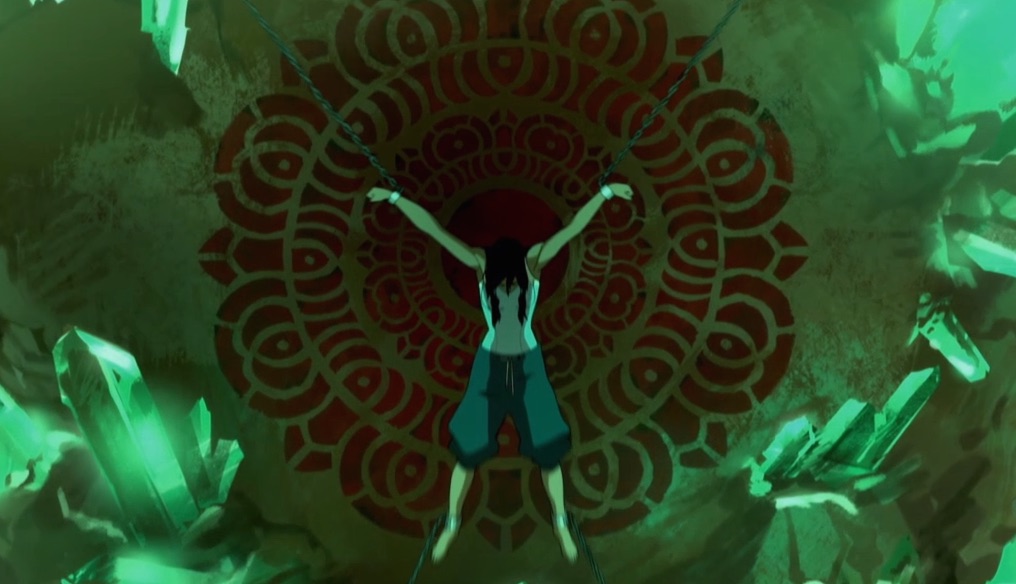
At the end of the season, Korra is captured by Zaheer, who poisons her with a metallic substance that sends her uncontrollably into the avatar state, putting her at risk of ending the entire avatar cycle.

Zaheer begins to steal Korra’s breath with his airbending.

This event serves as BOTH the climax for Book 3 and the inciting incident for Korra’s journey in Book 4.
Of course, Korra is able to defeat Zaheer and his clan, but Book 3 ends in an unusual place for a kids’ show–with Korra bound to a wheelchair and crying.
 Book 4 is where The Legend of Korra really proved itself to be a mature show. It took this horrific incident–Korra being poisoned and robbed of her breath–and treated it with an adult touch. The creators humanized Korra by asking, What would really happen to a person who went through this trauma? They decided that Korra was no longer going to be an invincible cartoon character. They gave her human vulnerability. They gave her PTSD.

This is different from anything we’ve ever seen on a TV show for this age level. Korra, robbed of her vitality, had to go through physical and emotional therapy to heal from the post-traumatic stress of her encounter with Zaheer. And here we were as an audience watching an animated character become so vulnerable that we couldn’t help but see her as human. That’s a powerful takedown of traditional storytelling norms, at least for children’s television.
The creators took Korra through a real healing process. She didn’t recover overnight; it took over 3 years. She struggled to walk again. She fell many times and she got back up. She lashed out at her healer Kitara. She pushed away those who care for her. She lied to her parents and went into hiding. She chopped off her hair. She lost much of her physical prowess and her notoriety as the avatar. She lost her connection to the spirit world.
Korra began Book 4 at her lowest point yet. This was her rock bottom for the entire series. The show’s creators turned their formula from Books 1 and 2 on its head. Instead of beginning strong and confronting a strong enemy, Korra began the season weak and had to build herself slowly to regain her power. This is a whole different character arc.
Korra was plagued with fear and poison. After a lonely journey across the world and into the spirit swamps she found Toph, an old avatar ally, who helped her extract the last of the poison (but only after much failure and resistance). Korra now thinks she’s ready to face Kuvira, the military aggressor and latest, greatest villain. But in a one-on-one battle with Kuvira, Korra’s nightmares haunt her again and she falls, defeated.
The beauty of Korra’s situation was that she had to heal herself. Just like in real life. What was really blocking her from reconnecting to herself was not the metallic poison (although that certainly wasn’t helping), but her fear. Every time Korra tried to return to battle, or to get better, she had flashbacks of all her traumatic events–the battle with Amon, the severing of her connection to Raava, but most of all her battle with Zaheer. In order to overcome her fear, Korra had to face its source by visiting Zaheer himself.

In one of the most poignant scenes of the series, Korra returned to visit her imprisoned enemy Zaheer and endured the traumatic flashbacks. She had to suffer through her fear in order to understand that her fear couldn’t kill her. That’s when she found peace, and her return to the spirit world. Her greatest enemy was the only one who could return her to the spirit world.
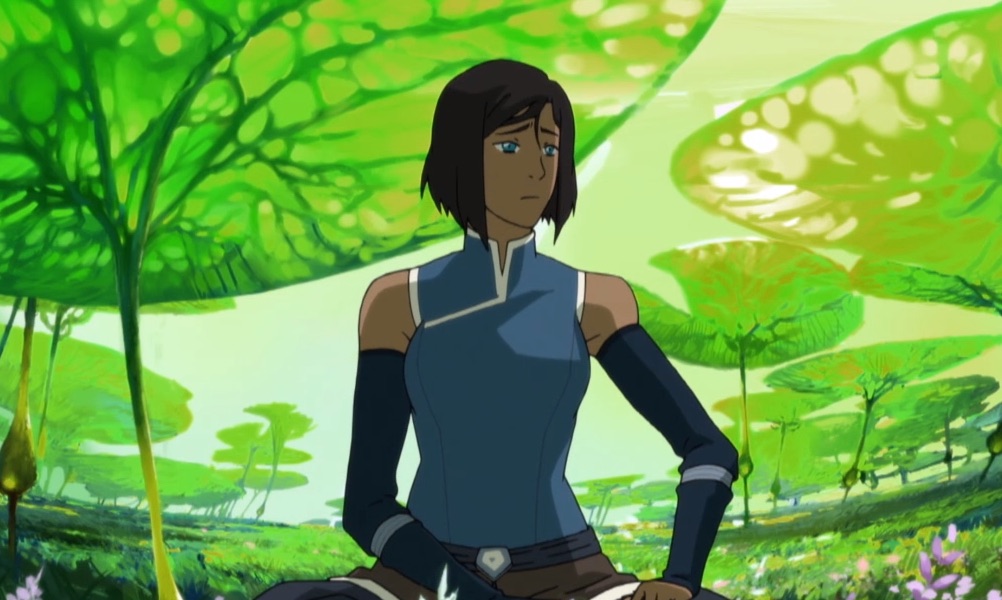
And to her connection with Raava. Korra finally becomes her whole self again.

This is the crucial turning point in Korra’s Book 4 arc.
What’s so meaningful about this journey is that Korra was shown depths of suffering she had never seen before, and the only way out of that suffering was confronting her enemies heart-to-heart. That confrontation softened her in a way that she had never been softened before. It taught her compassion–for herself, her own fear and suffering, as well as for the suffering of her enemies.
Thus, when Korra faces Kuvira in one final, epic battle in Republic City, she is able to take a bold step.
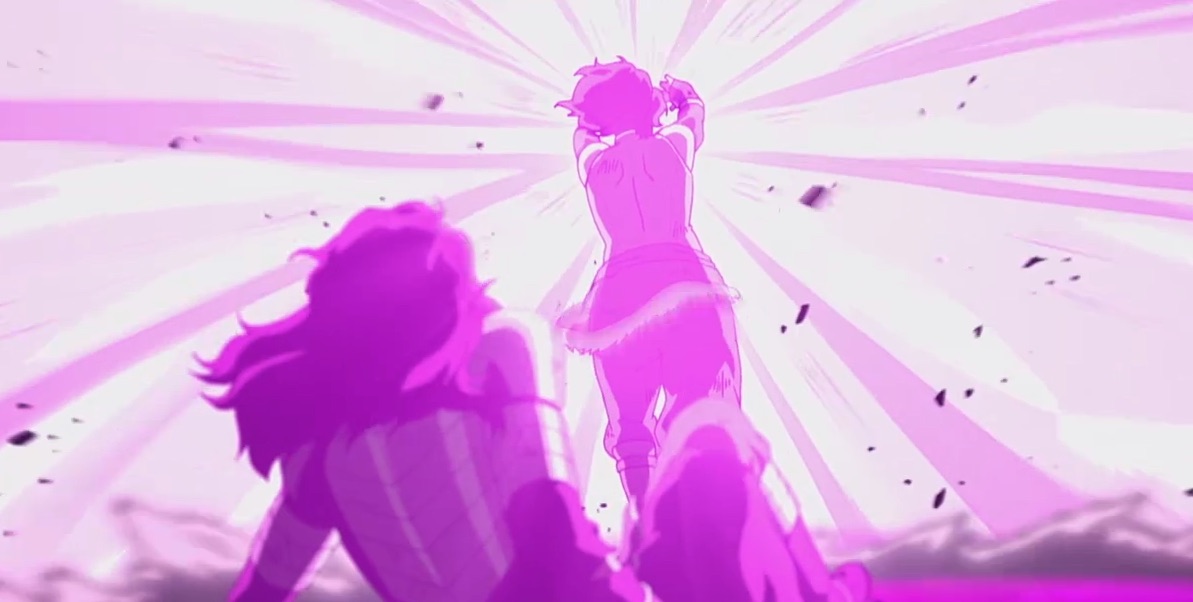
She puts herself in harm’s way in order to protect her enemy. Even though Kuvira has shown no remorse, wrecked Republic City, and destroyed the entire world’s social order, Korra saves her life (notably, Kuvira was endangered by her own mega-weapon). Korra understands that Kuvira, an orphan, has suffered much. She sees that Kuvira’s hostility was a due to her personal pain. She actually feels compassion for the woman that has caused so much mayhem and destruction.
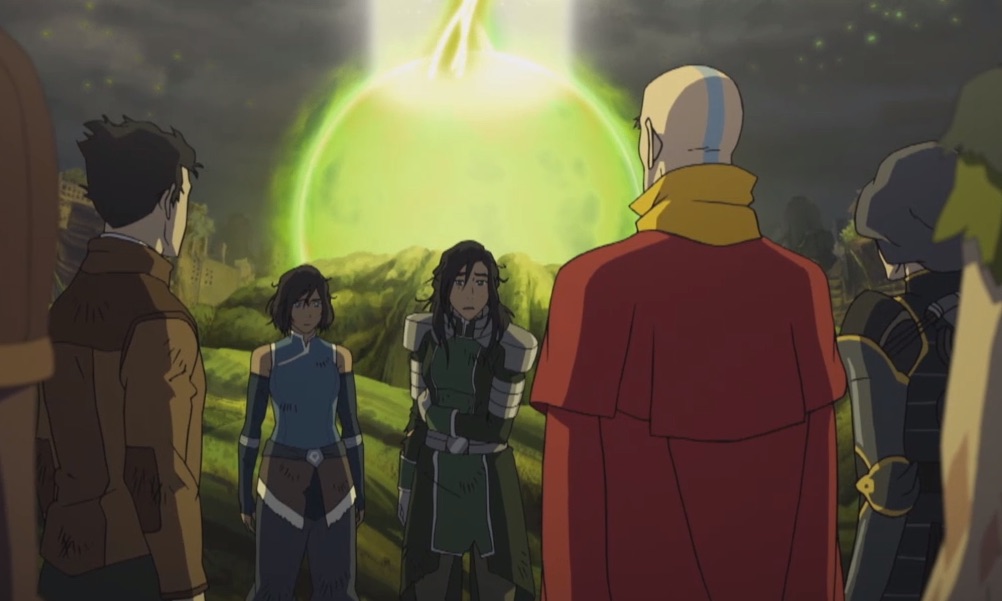
The Korra of Book 1 did not have this level of maturity. It’s only after facing such deep personal challenges that Korra finally brings her strength into balance with compassion. And this compassion pays off. Kuvira tells her troops to stand down, and the world comes to a greater sense of ease and understanding.
That is the culmination of Korra’s journey for the entire series. See, Korra’s arc through Books 3 and 4 completes who she’s been all along. By the end she has developed into a strong, faithful, compassionate warrior. She has truly brought the assets and flaws of her strength into balance!
Thank you for taking this journey with me and Korra.
Next time: Building the Avatar world.


 The Art of the Story