Part 1: The New Air Nation
Let’s start with this awesome shot from the first episode of Book 4:

Kai and Opal spot some barbarian raiders below

They leap and . . . off they go!
I know you all loved the moment that Kai and Opal spread their wings. I sure felt my heart rate pick up, and I whispered the words “I love this show so much.” It was an exceptionally surprising and thrilling moment to see the airbenders take flight in their brand new uniforms.
There’s no doubt that the Avatar world has some of the best wardrobe we’ve ever seen in animation (if not all of television…Game of Thrones excepted). But what’s the big deal? Why are so many avatar fans are obsessed with the show’s wardrobe? (Google “Avatar wardrobes”) It’s not just because it’s stylish (but also that). It’s because the show’s wardrobe is integrated into the world. It’s an excellent example of worldbuilding.
Kai and Opal’s costumes weren’t just some fancy new thing that an illustrator came up with out of nowhere. They were part of a long tradition of Air Nomad robes, updated for the new Air Nation and its peacekeeping mission. Look at how the color palette and patterns of the old robes were preserved. It’s still a crimson body and saffron collar, but it’s fitted for a new function: allowing airbenders to glide as they chase down bad guys.
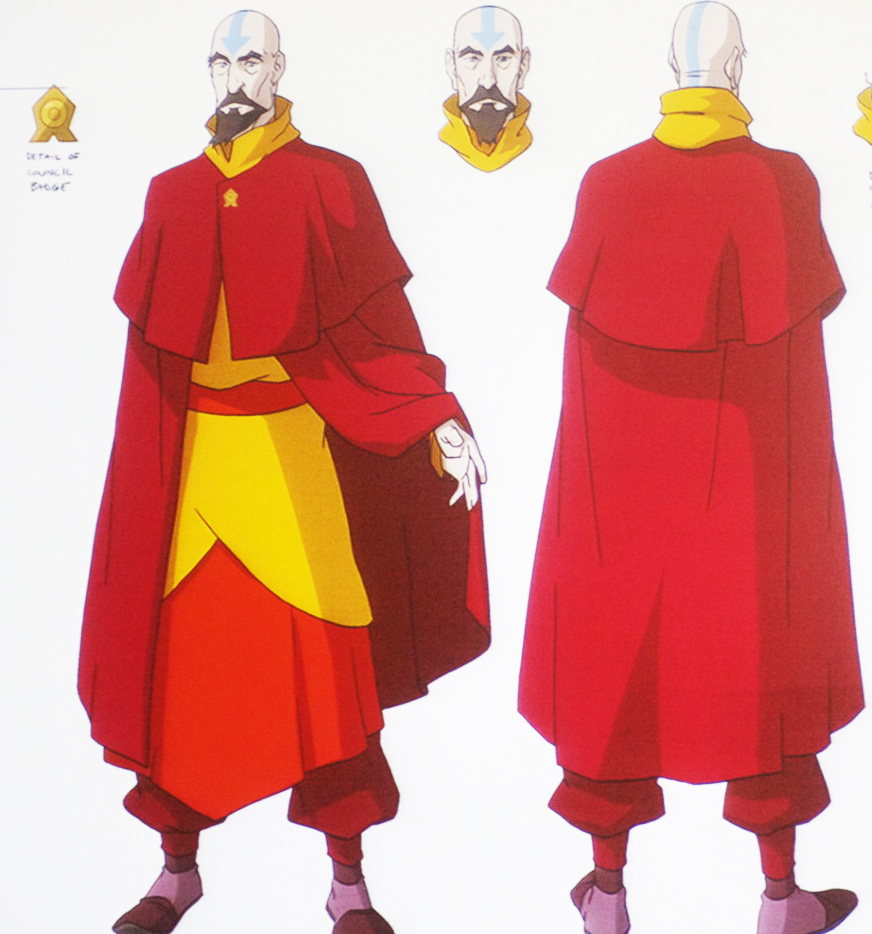
Tenzin’s robes
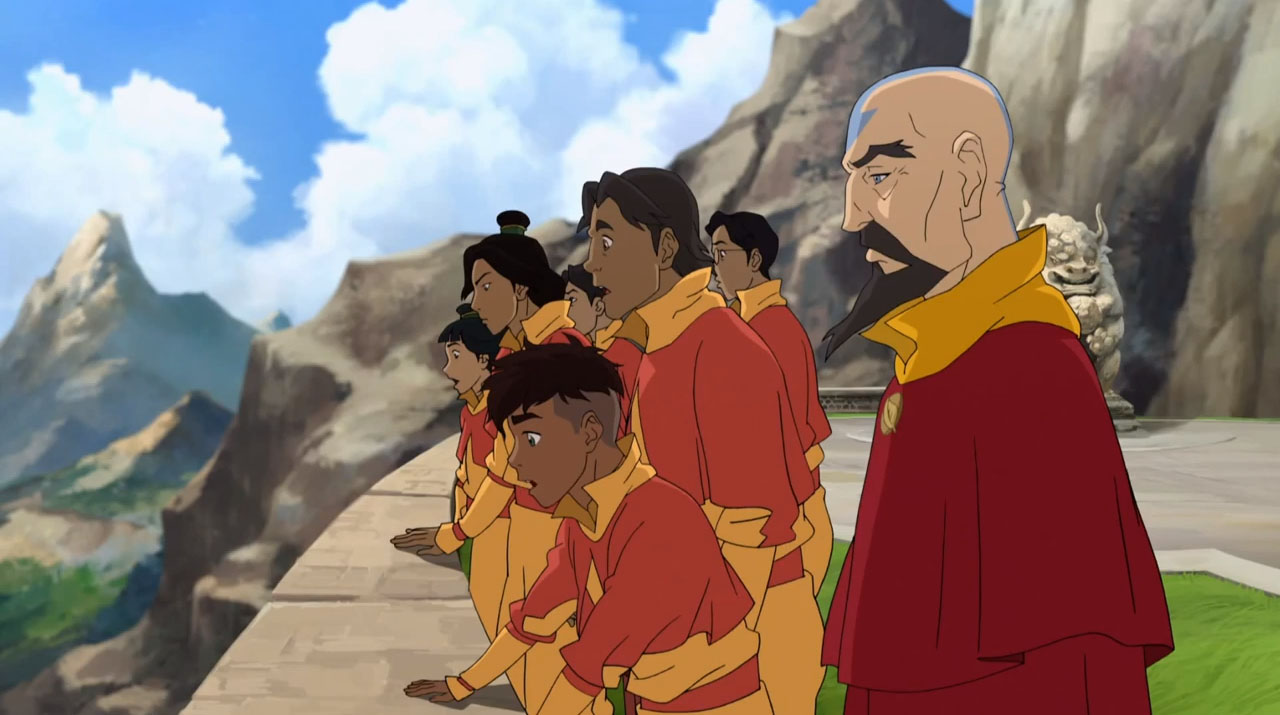
Traditional Air Nation Robes
This isn’t just about costumes. It’s about making the audience feel like they’re witnessing a full, rich, and dynamic world.
The Iceberg Effect

Look at how tiny the tip of the iceberg is when compared to the big hulking chunk underwater. The audience will only ever see the parts of the world that peek above the surface. But there’s a whole lot more underneath. Consider some visible and invisible aspects of culture:
Above the Surface: What the audience sees
Fashion, Architecture, Etiquette, Food, Arts, Rituals, Political Structures*
Below the Surface: What the audience infers
Values, Morals, Religious Ideas, History, Cosmology, Philosophy, Economy*
Above or below, these are all part of the culture! Just like the tip of the iceberg cannot exist without the body of ice underneath, styles and manners cannot be divorced from the historical and social forces that brought them to existence.
Fashion is a great example. To understand why people dressed the way they did in Victorian times, you have to look beyond bodices and tailcoats. Victorian fashions were a symptom of cultural values concerning gender, sexuality, class, race, industry, geography, transportation, etc. It’s all a single unit. You can’t think about the surface aspects of culture without considering the foundations underneath. Even the T-shirts, hoodies, and jeans we wear today are reflective of our modern attitudes towards gender and sexuality, democracy, meritocracy, irony, apathy, etc.
The way an audience experiences the world is going to be from the outside in. They’ll see the tip of the iceberg first, and then they’ll infer what’s underneath. As cultural details reveal themselves, the audience will gradually come to an understanding of what makes this society tick.
The writer or director has the awesome responsibility of deciding which parts of the world to show when. If the world is revealed too fast, the audience will be bored. Too slow and the audience will be lost. Too inconsistent, and you’ve violated the audience’s trust. Revealing the details of a world is a monumental task, which is why so many creators get it wrong, and why an audience is thrilled when we get it right.
Now, when the creators build the world, they build it from the bottom up. First they create the body of the iceberg, and then they decide what floats to the top, above the surface. The way the viewers experience the world is the opposite of how the creators write it.
That is to say, creators must have a solid understanding of the historical, political, religious, and social forces in their world before they attempt to adorn it with details. Before I wrote my epic sci-fi novel, I wrote a full history detailing how and why the world got to where it was. I took into account trade, war, geography, mythology, race, and language. Ignoring those foundations would have led me to create an empty, superficial world.
Let’s get back to the Air Nation
Now that we have a solid understanding of worldbuilding mechanics, here are some pretty pictures!
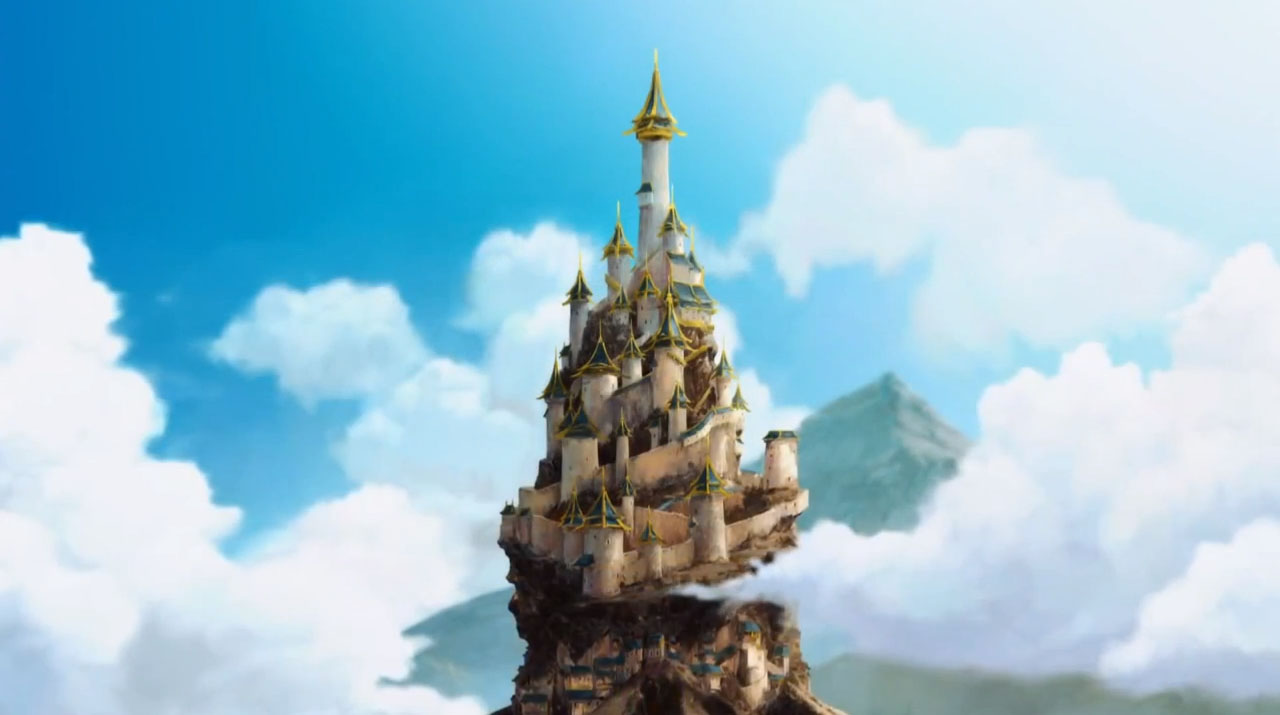
The Northern Air Temple
To illustrate my point about icebergs, look at the architecture and geography of the Northern Air Temple. The Air Nomads built this temple in line with their practical needs and moral values. The Temple is situated atop a mountain, where it is protected. It has several towers, walls, and spires which make it readily accessible only to flying creatures like airbenders. This defensive structure tells us that the Air Nomads were not military or aggressive, but kept to themselves. Its clean and simple form reflects their ascetic values. The way it blends into the mountain shows us that the Air Nomads sought harmony with their surroundings.
The temple fits in with the character of the Air Nation. It’s not just a pretty building (although it is that too).

Spirits Near the Air Temple
Spirits gather near the Air Temple. Again, the creators didn’t draw these spirits here just because they wanted some cute critters and gorgeous composition. Having spirits near the temple is motivated by story. It shows us that spirits are attracted to this place, and not just any type of spirit, but a plurality of small, gentle, and flying creatures. The Air Nation is vegetarian and pacifist, and it’s recovering from a genocide. The detail of these spirits here reminds us of the peace and courage of the Air Nation. You certainly wouldn’t see spirits like these in an unstable, segregated city like Ba Sing Se.

Tenzin’s family sits down for dinner
Rituals around food are some of the best ways to expose the nuances of a culture, because everybody needs to eat and everybody does it differently. Look at how Tenzin gathers with his family. They sit around a square table at a low height, recite their Air Nomad grace, and then eat a modest vegetarian meal. In this case, we’re getting insight not just into the culture of the Air Nation, but into Tenzin’s particular family culture.
Next time
In a large and pluralistic world like Korra’s, there are many different cultures. This adds a layer of complexity to the worldbuliding, as you have to consider how the different cities and nations interact, trade, go to war, communicate, etc. It’s like building several worlds and then making sure that they connect logically.
*note: Politics and Economy are both visible and invisible in unique ways, so I did not explore them here. They are important to worldbuilding, but we'll save them for different discussion.
 The Art of the Story
Pingback: The Legend of Korra: Plotting for High Stakes | The Art of the Story
Pingback: The Legend of Korra | The Art of the Story